
Raspberry Pi


Visit our blog to get more info on what you can do with your Pico
This is the Pico model H with pre-soldered connectors. Raspberry Pi Pico H is fitted with a pre-soldered 40-way header and 3-pin JTAG connector, for greater ease of use in hobbyist and industrial applications.
https://www.raspberrypi.org/blog/raspberry-pi-silicon-pico-now-on-sale/
https://www.raspberrypi.org/products/raspberry-pi-pico/
https://www.youtube.com/watch?v=ZY-HrRGCQ4w
YouTube video on Pico by Jeff Geerling
Raspberry Pi Pico, a microcontroller board built on silicon designed here at Raspberry Pi.
Whether you choose to use our C/C++ SDK, or the official MicroPython port, everything you need to get started is here. You’ll also find links to the technical documentation for both the Raspberry Pi Pico microcontroller board and our RP2040 microcontroller chip.
Board Specifications
- RP2040 microcontroller chip designed by Raspberry Pi in the United Kingdom
- Dual-core ARM Cortex M0+ processor, flexible clock running up to 133 MHz
- 264kB of SRAM, and 2MB of on-board Flash memory
- Castellated module allows soldering direct to carrier boards
- USB 1.1 Host and Device support
- Low-power sleep and dormant modes
- Drag & drop programming using mass storage over USB
- 26 multi-function GPIO pins
- 2×SPI, 2×I2C, 2×UART, 3×12-bit ADC, 16×controllable PWM channels
- Accurate clock and timer on-chip
- Temperature sensor
- Accelerated floating point libraries on-chip
- 8×Programmable IO (PIO) state machines for custom peripheral support
Download Pinout Diagram
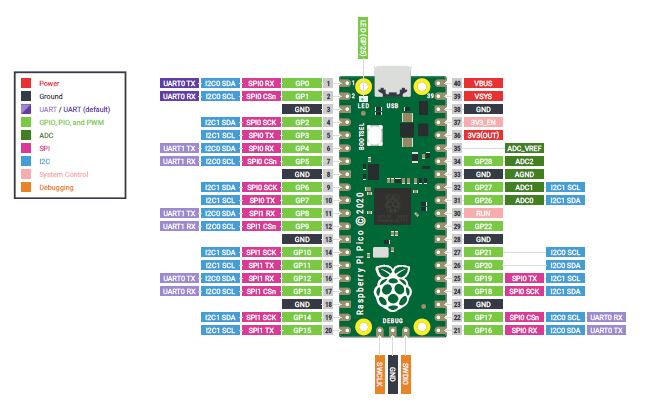
Documentation
Documentation for the Raspberry Pi Pico board and the RP2040 microcontroller:
Raspberry Pi Pico Datasheet
An RP2040-based microcontroller board
RP2040 Datasheet
A microcontroller by Raspberry Pi
Hardware design with the RP2040
Using the RP2040 microcontroller to build boards and products
Getting Started with Raspberry Pi Pico
C/C++ development with the Pico and other RP2040-based microcontroller boards
Pico C/C++ SDK
Libraries and tools for C/C++ development on the RP2040 microcontroller
Pico Python SDK
A MicroPython environment for the RP2040 microcontroller
The API level Doxygen documentation for the Raspberry Pi Pico C/C++ SDK is available as a micro-site.
1 x Raspberry Pi Pico H
Resources
- Support docs available here
- Getting Started with Raspberry Pi Pico (pdf), C/C++ Development with the Pico and other RP2040-based microcontroller boards
- Raspberry Pi Pico W Datasheet (pdf)
- Raspberry Pi Pico Datasheet (pdf), An RP2040-based microcontroller board
- Pico Python SDK (pdf), A MicroPython Environment for the RP2040 Microcontroller
- Pico C/C++ SDK (pdf), Libraries and Tools for C/C++ Development on the RP2040 Microcontroller
- RP2040 Datasheet (pdf), A microcontroller by Raspberry Pi
- Mating Plug for the Debug connector, SHR-03V-S-B, we have never tested before though :)
- Quick-Start the Pico W WiFi with CircuitPython, by Liz Clark, at learn.adafruit
- A New Challenger in MCU Platform – Raspberry Pi Pico, an article about Raspberry Pi Pico and RP2040
- Raspberry Pi Pico Vs Arduino UNO R3, an article to compare the spec of RPi Pico and Arduino UNO R3
- A New Challenger in MCU Platform – Raspberry Pi Pico, an article about Raspberry Pi Pico and RP2040
- Raspberry Pi Pico Vs Arduino UNO R3, an article to compare the spec of RPi Pico and Arduino UNO R3
Our Approved Reseller partners at Core Electronics offer a comprehensive Raspberry Pi Pico course.

Visit our blog to get more info on what you can do with your Pico
Raspberry Pi Pico W is a microcontroller board based on the Raspberry Pi RP2040 microcontroller chip.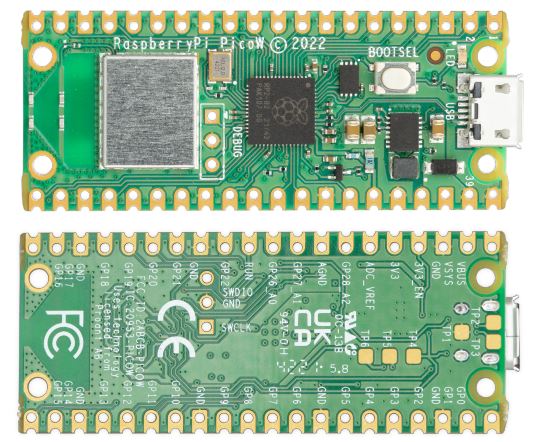
Raspberry Pi Pico W has been designed to be a low cost yet flexible development platform for RP2040, with a 2.4GHz wireless interface and the following key features:
• RP2040 microcontroller with 2MB of flash memory
• On-board single-band 2.4GHz wireless interfaces (802.11n)
• Micro USB B port for power and data (and for reprogramming the flash)
• 40 pin 21mmx51mm 'DIP' style 1mm thick PCB with 0.1" through-hole pins also with edge castellations
◦ Exposes 26 multi-function 3.3V general purpose I/O (GPIO)
◦ 23 GPIO are digital-only, with three also being ADC capable
◦ Can be surface mounted as a module
• 3-pin ARM serial wire debug (SWD) port
• Simple yet highly flexible power supply architecture
◦ Various options for easily powering the unit from micro USB, external supplies or batteries
• High quality, low cost, high availability
• Comprehensive SDK, software examples and documentation
For full details of the RP2040 microcontroller please see the RP2040 Datasheet book. Key features include:
• Dual-core cortex M0+ at up to 133MHz
◦ On-chip PLL allows variable core frequency
• 264kByte multi-bank high performance SRAM
• External Quad-SPI Flash with eXecute In Place (XIP) and 16kByte on-chip cache
• High performance full-crossbar bus fabric
• On-board USB1.1 (device or host)
• 30 multi-function general purpose I/O (four can be used for ADC)
◦ 1.8-3.3V I/O voltage
• 12-bit 500ksps analogue to digital converter (ADC)
• Various digital peripherals
◦ 2 × UART, 2 × I2C, 2 × SPI, 16 × PWM channels
◦ 1 × timer with 4 alarms, 1 × real time clock
• 2 × programmable I/O (PIO) blocks, 8 state machines in total
◦ Flexible, user-programmable high-speed I/O
◦ Can emulate interfaces such as SD card and VGA
NOTE - Raspberry Pi Pico W I/O voltage is fixed at 3.3V
Raspberry Pi Pico W provides a minimal yet flexible external circuitry to support the RP2040 chip: flash memory (Winbond W25Q16JV), a crystal, power supplies and decoupling, and USB connector. The majority of the RP2040 microcontroller pins are brought to the user IO pins on the left and right edge of the board. Four RP2040 I/O are used for internal functions: driving an LED, on-board switch mode power supply (SMPS) power control, and sensing the system voltages.
Pico W has an on-board 2.4GHz wireless interface using an Infineon CYW43439. The antenna is an onboard antenna licensed from ABRACON (formerly ProAnt). The wireless interface is connected via SPI to the RP2040.
Pico W has been designed to use either soldered 0.1-inch pin-headers (it is one 0.1-inch pitch wider than a standard 40-pin DIP package), or to be positioned as a surface mountable 'module', as the user I/O pins are also castellated. There
are SMT pads underneath the USB connector and BOOTSEL button, which allow these signals to be accessed if used as a reflow-soldered SMT module.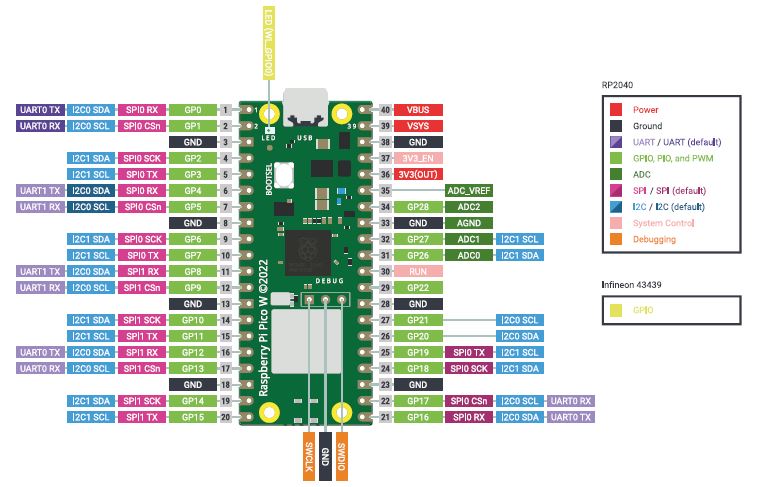
What's in the box?
1 x Raspberry Pi Pico W
Resources
- Support docs available here
- Getting Started with Raspberry Pi Pico (pdf), C/C++ Development with the Pico and other RP2040-based microcontroller boards
- Raspberry Pi Pico W Datasheet (pdf)
- Raspberry Pi Pico Datasheet (pdf), An RP2040-based microcontroller board
- Pico Python SDK (pdf), A MicroPython Environment for the RP2040 Microcontroller
- Pico C/C++ SDK (pdf), Libraries and Tools for C/C++ Development on the RP2040 Microcontroller
- RP2040 Datasheet (pdf), A microcontroller by Raspberry Pi
- Mating Plug for the Debug connector, SHR-03V-S-B, we have never tested before though :)
- Quick-Start the Pico W WiFi with CircuitPython, by Liz Clark, at learn.adafruit
- A New Challenger in MCU Platform – Raspberry Pi Pico, an article about Raspberry Pi Pico and RP2040
- Raspberry Pi Pico Vs Arduino UNO R3, an article to compare the spec of RPi Pico and Arduino UNO R3
- A New Challenger in MCU Platform – Raspberry Pi Pico, an article about Raspberry Pi Pico and RP2040
- Raspberry Pi Pico Vs Arduino UNO R3, an article to compare the spec of RPi Pico and Arduino UNO R3
Our Approved Reseller partners at Core Electronics offer a comprehensive Raspberry Pi Pico course.

The Raspberry Pi Debug Probe is an inexpensive, all-in-one USB to serial debug and UART bridge. It provides the necessary hardware and cabling to support “plug and play” debugging of Raspberry Pi Pico and other microcontroller- and microprocessor-based platforms.
The Raspberry Pi Debug Probe provides both a processor serial debug interface (by default this is the ARM Serial Wire Debug interface) and an industry-standard UART interface. Both interfaces use a 3-pin debug connector, as specified in the Raspberry Pi 3-pin debug connector specification.
The Raspberry Pi Debug Probe is provided as a kit, containing the probe hardware in a plastic case, and a set of cables: a USB cable, and
three different types of debug cable to cover the vast majority of use cases.
While it has been designed primarily for use with Raspberry Pi debug targets, the Debug Probe provides standard CMSIS-DAP debug and UART interfaces over USB; it can therefore be used to debug other targets, or simply as a cost-effective USB-to-UART cable.
The Raspberry Pi Debug Probe is based on the Raspberry Pi Pico hardware design and runs the open-source Raspberry Pi Picoprobe software https://github.com/raspberrypi/picoprobe. Updating the firmware is accomplished in the same way as on a Raspberry Pi Pico, so it is straightforward to keep the unit up to date with the latest Picoprobe firmware, or to use a custom firmware.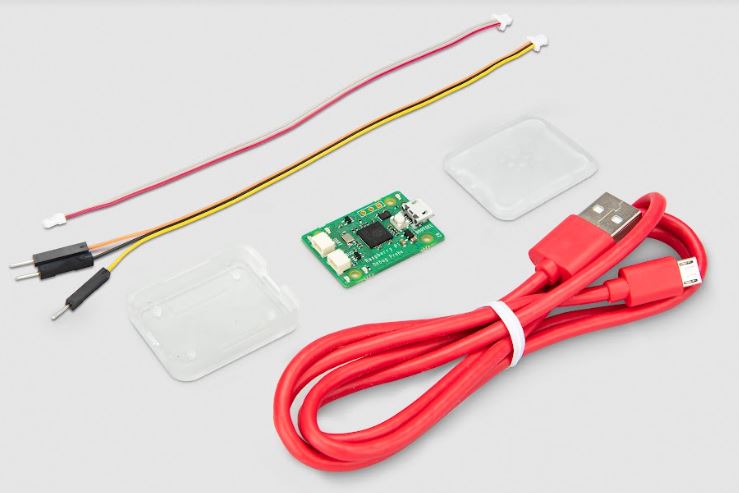
What's in the box?
1 x Debug Probe
1 x Probe plastic case
1 x USB A to USB micro B cable
3 x debug cables
Resources
- https://datasheets.raspberrypi.com/debug/debug-connector-specification.pdf
- Raspberry Pi Debug Probe product brief
- Raspberry Pi Debug Probe documentation
Debug Probe firmware v2.2.1 - there is a new firmware update for the Debug Probe available. Please use this link to download the update - https://github.com/

Please note: You will need to buy a different CSI cable for use with RPi 5 or ZERO.
Raspberry Pi Camera Module 3 is a compact camera from Raspberry Pi. It offers an IMX708 12-megapixel sensor with HDR, and features phase detection autofocus. Camera Module 3 is available in standard and wide-angle variants, both of which are available with or without an infrared cut filter.
Camera Module 3 can be used to take full HD video as well as stills photographs, and features an HDR mode up to 3 megapixels. Its operation is fully supported by the libcamera library, including Camera Module 3’s rapid autofocus feature: this makes it easy for beginners to use, while offering plenty for advanced users. Camera Module 3 is compatible with all Raspberry Pi computers. ( Excluding early Raspberry Pi Zero models, which lack the necessary FPC connector. Later Raspberry Pi Zero models require an adapter FPC, sold separately.)
The PCB size and mounting holes remain the same as for Camera Module 2.
The Z dimension differs: due to the improved optics, Camera Module 3 is several millimetres taller than Camera Module 2.
All variants of Camera Module 3 feature:
• Back-illuminated and stacked CMOS 12-megapixel image sensor (Sony IMX708)
• High signal-to-noise ratio (SNR)
• Built-in 2D Dynamic Defect Pixel Correction (DPC)
• Phase Detection Autofocus (PDAF) for rapid autofocus
• QBC Re-mosaic function
• HDR mode (up to 3 megapixel output)
• CSI-2 serial data output
• 2-wire serial communication (supports I2C fast mode and fast-mode plus)
• 2-wire serial control of focus mechanism
What's in the box?
1 x Raspberry pi camera module 3
Resources:
Latest updates and news available at https://www.raspberrypi.com/products/camera-module-3/

Please note: You will need to buy a different CSI cable for use with RPi 5 or ZERO.
Raspberry Pi Camera Module 3 is a compact camera from Raspberry Pi. It offers an IMX708 12-megapixel sensor with HDR, and features phase detection autofocus. Camera Module 3 is available in standard and wide-angle variants, both of which are available with or without an infrared cut filter.
Camera Module 3 can be used to take full HD video as well as stills photographs, and features an HDR mode up to 3 megapixels. Its operation is fully supported by the libcamera library, including Camera Module 3’s rapid autofocus feature: this makes it easy for beginners to use, while offering plenty for advanced users. Camera Module 3 is compatible with all Raspberry Pi computers. ( Excluding early Raspberry Pi Zero models, which lack the necessary FPC connector. Later Raspberry Pi Zero models require an adapter FPC, sold separately.)
The PCB size and mounting holes remain the same as for Camera Module 2.
The Z dimension differs: due to the improved optics, Camera Module 3 is several millimetres taller than Camera Module 2.
All variants of Camera Module 3 feature:
• Back-illuminated and stacked CMOS 12-megapixel image sensor (Sony IMX708)
• High signal-to-noise ratio (SNR)
• Built-in 2D Dynamic Defect Pixel Correction (DPC)
• Phase Detection Autofocus (PDAF) for rapid autofocus
• QBC Re-mosaic function
• HDR mode (up to 3 megapixel output)
• CSI-2 serial data output
• 2-wire serial communication (supports I2C fast mode and fast-mode plus)
• 2-wire serial control of focus mechanism
What's in the box?
1 x Raspberry pi camera module 3
Resources:
Latest updates and news available at https://www.raspberrypi.com/products/camera-module-3/

Please note: You will need to buy a different CSI cable for use with RPi 5 or ZERO.
Raspberry Pi Camera Module 3 is a compact camera from Raspberry Pi. It offers an IMX708 12-megapixel sensor with HDR, and features phase detection autofocus. Camera Module 3 is available in standard and wide-angle variants, both of which are available with or without an infrared cut filter.
Camera Module 3 can be used to take full HD video as well as stills photographs, and features an HDR mode up to 3 megapixels. Its operation is fully supported by the libcamera library, including Camera Module 3’s rapid autofocus feature: this makes it easy for beginners to use, while offering plenty for advanced users. Camera Module 3 is compatible with all Raspberry Pi computers. ( Excluding early Raspberry Pi Zero models, which lack the necessary FPC connector. Later Raspberry Pi Zero models require an adapter FPC, sold separately.)
The PCB size and mounting holes remain the same as for Camera Module 2.
The Z dimension differs: due to the improved optics, Camera Module 3 is several millimetres taller than Camera Module 2.
All variants of Camera Module 3 feature:
• Back-illuminated and stacked CMOS 12-megapixel image sensor (Sony IMX708)
• High signal-to-noise ratio (SNR)
• Built-in 2D Dynamic Defect Pixel Correction (DPC)
• Phase Detection Autofocus (PDAF) for rapid autofocus
• QBC Re-mosaic function
• HDR mode (up to 3 megapixel output)
• CSI-2 serial data output
• 2-wire serial communication (supports I2C fast mode and fast-mode plus)
• 2-wire serial control of focus mechanism
What's in the box?
1 x Raspberry pi camera module 3
Resources
Latest updates and news available at https://www.raspberrypi.com/products/camera-module-3/

Please note: You will need to buy a different CSI cable for use with RPi 5 or ZERO.
Raspberry Pi Camera Module 3 is a compact camera from Raspberry Pi. It offers an IMX708 12-megapixel sensor with HDR, and features phase detection autofocus. Camera Module 3 is available in standard and wide-angle variants, both of which are available with or without an infrared cut filter.
Camera Module 3 can be used to take full HD video as well as stills photographs, and features an HDR mode up to 3 megapixels. Its operation is fully supported by the libcamera library, including Camera Module 3’s rapid autofocus feature: this makes it easy for beginners to use, while offering plenty for advanced users. Camera Module 3 is compatible with all Raspberry Pi computers. ( Excluding early Raspberry Pi Zero models, which lack the necessary FPC connector. Later Raspberry Pi Zero models require an adapter FPC, sold separately.)
The PCB size and mounting holes remain the same as for Camera Module 2.
The Z dimension differs: due to the improved optics, Camera Module 3 is several millimetres taller than Camera Module 2.
All variants of Camera Module 3 feature:
• Back-illuminated and stacked CMOS 12-megapixel image sensor (Sony IMX708)
• High signal-to-noise ratio (SNR)
• Built-in 2D Dynamic Defect Pixel Correction (DPC)
• Phase Detection Autofocus (PDAF) for rapid autofocus
• QBC Re-mosaic function
• HDR mode (up to 3 megapixel output)
• CSI-2 serial data output
• 2-wire serial communication (supports I2C fast mode and fast-mode plus)
• 2-wire serial control of focus mechanism
What's in the box?
1 x Raspberry pi camera module 3
Resources:
Latest updates and news available at https://www.raspberrypi.com/products/camera-module-3/

Please note: You will need to buy a different CSI cable for use with RPi 5 or ZERO.
The Raspberry Pi High Quality Camera is an affordable high-quality camera from
Raspberry Pi. It offers 12-megapixel resolution and a 7.9mm-diagonal sensor for
impressive low-light performance. The M12 Mount variant is designed to work with most interchangeable M12 lenses, and the CS Mount variant is designed to work with interchangeable lenses in both CS- and C-mount form factors (C-mount lenses require the use of the C-CS adapter included with this variant). Other lens form factors can be accommodated using third-party lens adapters.
The High Quality Camera is well suited to industrial and consumer applications,
including security cameras, which require the highest levels of visual fidelity and/ or integration with specialist optics. It is compatible with all models of Raspberry Pi computer from Raspberry Pi 1 Model B onwards, using the latest software release from raspberrypi.com.
The package comprises a circuit board carrying a Sony IMX477 sensor, an FPC cable for connection to a Raspberry Pi computer, and a milled aluminium lens mount with integrated tripod mount. The CS Mount variant lens mount features a focus adjustment ring, and this variant ships with a C- to CS-mount adapter; the M12 Mount variant ships with three lens locking rings (one required plus two spare).
What's in the box?
1 x M12 HQ camera
You might also need...
- black flexible mini tripod
- Zero mounting plate for HQ cameraa
- Pi3/4/5 mounting plate for HQ cameras
Resources
HQ Camera product brief: https://datasheets.raspberrypi.com/hq-c ... -brief.pdf

Please note: You will need to buy a different CSI cable for use with RPi 5 or ZERO. If the Red and Blue colours are swapped on your camera, then you need to update the Pi firmware.
A camera for motion photography and machine vision
Built around Sony’s 1.6-megapixel IMX296 sensor, the Global Shutter Camera is able to capture rapid motion without introducing rolling shutter artefacts. This makes it a great fit for sports photography, and for machine vision applications, where even small amounts of distortion can seriously degrade inference performance.
Rolling shutters, global shutters
Every camera we’ve released to date, from 2014’s Camera Module 1 to our High Quality Camera and beyond, has used a rolling shutter sensor. These sensors have a two-dimensional array of light-sensitive pixels, which generate an analogue value proportional to the amount of light falling on the pixel during the exposure time; and a row of analogue-to-digital converters (ADCs), which convert these analogue values into digital values which are fed back to your Raspberry Pi.
The row of ADCs is connected to each row of the pixel array in turn, so each row is sampled at a slightly different time. Provided there is no motion in the scene this isn’t a problem, but once things start to move — and particularly if something is moving fast — we start to see rolling shutter artefacts. Linear motion results in compression, stretching, or shearing of the moving object. Rotary motion can create some very odd-looking shapes indeed.
Severe rolling shutter artefacts are unsightly, and hard to detect and correct, but even imperceptible artefacts can interfere with the operation of machine vision algorithms. If we want to eliminate them altogether, we need to use a global shutter sensor. This pairs each pixel with an analogue storage element; when the shutter fires, each pixel immediately copies its analogue value into its storage element, from where it can be read and converted at leisure.
The storage element adds complexity and area to each pixel. Global shutter sensors tend to have a lower resolution than rolling shutter sensors of the same size: contrast the 7.9mm, 12-megapixel IMX477 sensor used in the High Quality Camera with the 6.3mm, 1.6-megapixel IMX296.
Enter the Raspberry Pi Global Shutter Camera
Despite the challenges associated with rolling shutter artefacts, our existing cameras are widely used in hobbyist and industrial machine vision applications. And we’ve seen some real ingenuity: to compensate for artefacts when imaging products on a high-speed conveyor belt, one of our industrial customers ended up training their models using pre-sheared input data.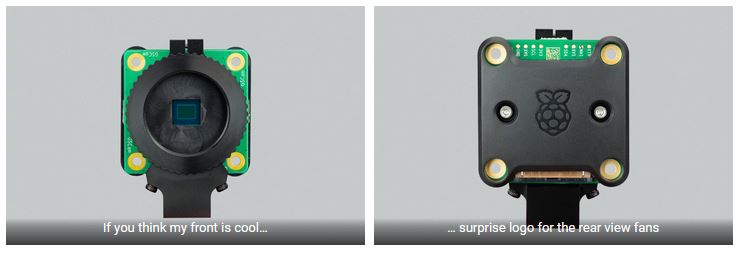
For these applications, a global shutter sensor offers clear advantages. And reduced resolution isn’t a problem, as high-resolution images are generally down-sampled before being fed into machine vision models.
The Raspberry Pi Global Shutter Camera combines the C/CS-mount metalwork of our High Quality Camera with Sony’s IMX296 sensor. It is compatible with the same broad variety of lenses, including the 6mm CS‑mount and 16mm C-mount CGL lenses that we offer through our Approved Reseller partners.
The video below illustrates the benefits of a global shutter in the presence of rapid rotary motion. First we see the output from the High Quality Camera, showing distinctive rolling shutter artefacts, and then we see the artefact-free output from the Global Shutter Camera.
Like all our camera products, you can use the Global Shutter Camera with any Raspberry Pi computer that has a CSI camera connector, and we’ve updated our hardware documentation to include everything you need to know about the new product.
You’ll need to update Raspberry Pi OS to use the new camera: sudo apt update; sudo apt full-upgrade; sudo reboot and you’re good to go.
Specifications
- Form factor: 38 × 38 × 19.8mm (29.5mm adapter and dust cap)
- Weight: 34g (41g with adapter and dust cap)
- Sensor: Sony IMX296LQR-C
- Resolution: 1.58 megapixels (colour)
- Sensor size: 6.3mm sensor diagonal
- Pixel size: 3.45μm × 3.45μm
- Output: RAW10
- Back focus length of lens: Adjustable (12.5–22.4mm)
- Lens standards: CS-Mount, C-Mount (C-CS adapter included)
- IR cut filter: Integrated
- Ribbon cable length: 150mm
- Included accessories: C-CS mount adapter, screwdriver
- Tripod mount: 1/4”-20
What's in the box?
1 x Raspberry Pi Global Shutter Camera
You might also need...
- black flexible mini tripod
- Zero mounting plate for HQ cameraa
- Pi3/4 mounting plate for HQ cameras
- 16mm telephoto lens
- 6mm wide angle camera lens
Resources
The Raspberry Pi 5 desktop kit offers a compact and powerful computing solution. Featuring the latest Raspberry Pi model, it includes all essential peripherals for seamless desktop use. With enhanced performance and versatility, this kit is perfect for DIY enthusiasts, educators, and professionals alike, enabling a wide range of projects from coding to media streaming and beyond.
What's in the box?
1 x Raspberry Pi 8GB board
1 x Official Raspberry Pi 5 Case(red/white) - Includes heatsink and fan
1 x Official 27W USB-C PD Power Supply(white)
1 x Official Keyboard(red/white)
1 x Official Mouse(red/white)
1 x 32GB SD card with Raspberry Pi OS
2 x Official micro-HDMI cables(white)
1 x The fifth edition of the Raspberry Pi Beginner’s Guide
Add an HDMI monitor for the ultimate desktop experience
You will also need a euro plug adapter
Resources

Lets you read the micro SD card(Not Included) in a standard SD card reader slot, whether on a laptop, or a PC bay with a card reader. Or it enables you to use the micro card in a device such as a standard camera or video recorder which uses a regular SD card.
What's in the box?
1 x Micro SD to SD Adapter
Please note this is the adapter only. Micro SD card is not included
Featuring a 64-bit quad-core Arm Cortex-A76 processor running at 2.4GHz, Raspberry Pi 5 delivers a 2–3× increase in CPU performance relative to Raspberry Pi 4. Alongside a substantial uplift in graphics performance from an 800MHz VideoCore VII GPU; dual 4Kp60 display output over HDMI; and state-of-the-art camera support from a rearchitected Raspberry Pi Image Signal Processor, it provides a smooth desktop experience for consumers, and opens the door to new applications for industrial customers.
For the first time, this is a full-size Raspberry Pi computer using silicon built in-house at Raspberry Pi. The RP1 “southbridge” provides the bulk of the I/O capabilities for Raspberry Pi 5, and delivers a step change in peripheral performance and functionality. Aggregate USB bandwidth is more than doubled, yielding faster transfer speeds to external UAS drives and other high-speed peripherals; the dedicated two-lane 1Gbps MIPI camera and display interfaces present on earlier models have been replaced by a pair of four-lane 1.5Gbps MIPI transceivers, tripling total bandwidth, and supporting any combination of up to two cameras or displays; peak SD card performance is doubled, through support for the SDR104 high-speed mode; and for the first time the platform exposes a single-lane PCI Express 2.0 interface, providing support for high-bandwidth peripherals.
Specifications
Processor
Broadcom BCM2712 2.4GHz quad-core 64-bit Arm Cortex-A76 CPU,
with cryptography extensions, 512KB per-core L2 caches, and a
2MB shared L3 cache
Features
• VideoCore VII GPU, supporting OpenGL ES 3.1, Vulkan 1.2
• Dual 4Kp60 HDMI® display output with HDR support
• 4Kp60 HEVC decoder
• LPDDR4X-4267 SDRAM
(4GB and 8GB SKUs available at launch)
• Dual-band 802.11ac Wi-Fi®
• Bluetooth 5.0 / Bluetooth Low Energy (BLE)
• microSD card slot, with support for high-speed SDR104 mode
• 2 × USB 3.0 ports, supporting simultaneous 5Gbps operation
• 2 × USB 2.0 ports
• Gigabit Ethernet, with PoE+ support
(requires separate PoE+ HAT)
• 2 × 4-lane MIPI camera/display transceivers
• PCIe 2.0 x1 interface for fast peripherals
(requires separate M.2 HAT or other adapter)
• 5V/5A DC power via USB-C, with Power Delivery support
• Raspberry Pi standard 40-pin header
• Real-time clock (RTC), powered from external battery
• Power button
Production lifetime
Raspberry Pi 5 will remain in production until at least January 2035
Compliance: For a full list of local and regional product approvals, please visit pip.raspberrypi.com
What's in the box?
1 x Raspberry Pi 5 board
You might also need...
The Raspberry Pi board comes without the below items. Have a look at what else you still need to get going.
- download and install Raspberry Pi OS using Raspberry Pi imager or grab a uSD card with Raspberry Pi OS preloaded
- a USB type C power supply available in white or black
- a micro HDMI cable or HDMI adapter
- an enclosure/case for your Pi
- a battery for your RTC
- an active cooler for RPi5
- a keyboard and mouse
- a display monitor in red/white or black
Resources
The new 27W USB-C PD (Power Delivery) Power Supply will deliver a maximum of 5.1V, 5A enabling the Raspberry Pi 5 to power a wider range of peripherals.
The total power drawn from the four USB ports on Raspberry Pi 5 is limited by default to a nominal 600mA; this limit is automatically increased to a nominal 1.6A when the USB-C PD Power Supply is detected.
The USB-C PD Power Supply is also capable of delivering 3A @ 9V, 2.25A @ 12V, and 1.8A @ 15V to PD-compatible products, making it a good cost-effective power supply for many general-purpose, non-Raspberry Pi use cases.
Specifications
- Input: 100-240VAC
- Output: 5A @ 5.1V, 3A @ 9V, 2.25A @ 12V, 1.8A @ 15V
- Connector: USB-C
- Cable: 1.2m, 18awg
- Colours White, black
- Plug Types: US, Canada (type A), Europe (type C),UK (type G)
What's in the box?
1 x Power supply
You will also need a euro plug adapter
The new 27W USB-C PD (Power Delivery) Power Supply will deliver a maximum of 5.1V, 5A enabling the Raspberry Pi 5 to power a wider range of peripherals.
The total power drawn from the four USB ports on Raspberry Pi 5 is limited by default to a nominal 600mA; this limit is automatically increased to a nominal 1.6A when the USB-C PD Power Supply is detected.
The USB-C PD Power Supply is also capable of delivering 3A @ 9V, 2.25A @ 12V, and 1.8A @ 15V to PD-compatible products, making it a good cost-effective power supply for many general-purpose, non-Raspberry Pi use cases.
Specifications
- Input: 100-240VAC
- Output: 5A @ 5.1V, 3A @ 9V, 2.25A @ 12V, 1.8A @ 15V
- Connector: USB-C
- Cable: 1.2m, 18awg
- Colours White, black
- Plug Types: US, Canada (type A), Europe (type C),UK (type G)
What's in the box?
1 x Power supply
You will also need a euro plug adapter

This is an official Pi4 kit from the Raspberry Pi Foundation.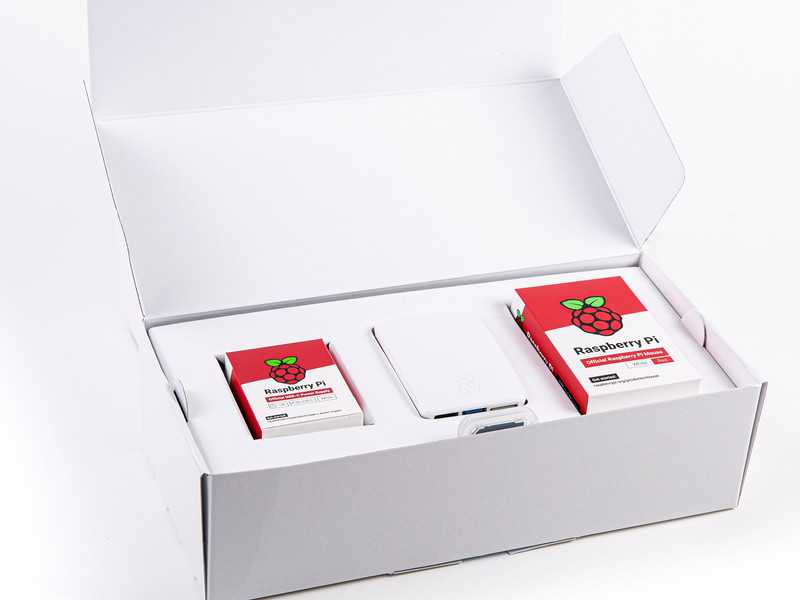
What's in the box?
- Raspberry Pi4 3GB computer
- Official Red/White Raspberry Pi4 case
- English Official Raspberry Pi Beginners guide
- US Official Raspberry Pi Red/White keyboard & mouse
- EU Official Raspberry Pi White power supply
- 2 ×Official micro-HDMI to HDMI-A (male) cables
- 32GB microSD card with Raspberry Pi OS pre-installed
Just add an official HDMI monitor
More info on the Pi4 available at https://www.raspberrypi.org/blog/raspberry-pi-4-on-sale-now-from-35/
and https://www.raspberrypi.org/products/raspberry-pi-4-model-b/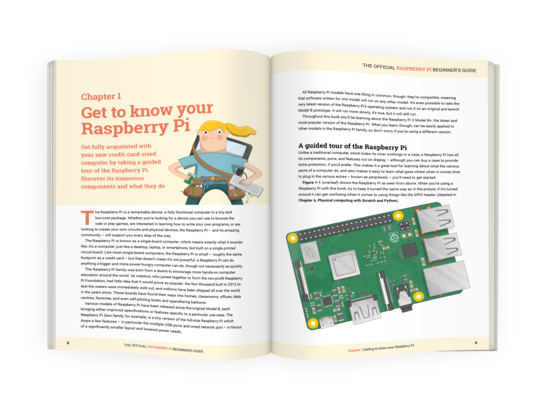
SD card quality is a critical factor in determining the overall user experience for a Raspberry Pi single-board computer. Recent cards support higher bus speeds, and the command queueing extension, which permits a degree of pipelining of random read operations; together these close some of the gap between SD card and NVMe SSD performance.
Specifications
- A2 class micro-SD cards with support for DDR50 and SDR104 bus speeds and command queueing (CQ) extension
- 64GB capacity
- Random 4KB read performance
- 3,200 IOPS (Raspberry Pi 4, DDR50)
- 5,000 IOPS (Raspberry Pi 5, SDR104)
- Random 4K write performance
- 1,200 IOPS (Raspberry Pi 4, DDR50)
- 2,000 IOPS (Raspberry Pi 5, SDR104)
What's in the box?
1 x Raspberry Pi A2-Class SD card
Resources
Raspberry Pi Operating System Downloads: https://www.raspberrypi.org/downloads/
Read more on the Raspberry Pi Blog article
Updates
13/10/2025 - Pre-Programmed 64bit with Raspbian_Bookworm_2025-09-25 Individually packed (SD Adaptor in Jewel case)

The Official Raspberry Pi Mouse 2 is finally here!
This sleek, stylish and ergonomic mouse from the team at Raspberry Pi includes three buttons, two main ones for right and left click, and a scroll wheel with button for scrolling. . . and more clicking. . . what more do you need from a mouse!
Mouse Specifications
- Three-button optical mouse
- Scroll wheel
- USB type-A connector
- Compatible with all Raspberry Pi products
- Ergonomic design for comfortable use
- Available in Black and White
Getting Started
Our official mouse has three buttons, which activate high-quality micro-switches. The wheel is for quick scrolling when browsing documents and web pages.
Always place the mouse on a flat, stable surface while using it. The mouse optically detects movement on the surface on which it is placed. On featureless surfaces, e.g. PVC or acrylic table tops, the mouse cannot detect movement. When you are working on such a surface, place the mouse on a mouse mat.
What's in the box?
1 x USB mouse black
In comparison with its predecessor, RP2040, RP235x offers:
- A 150MHz system clock (versus 133MHz)
- Dual Arm Cortex-M33 cores (versus dual Arm Cortex-M0+)
- Dual RISC-V Hazard3 cores
- 520KB RAM (versus 264KB)
- 8KB on-chip OTP storage
- A comprehensive security model, based on Arm TrustZone for Cortex-M
- Greatly improved power efficiency
Raspberry Pi Pico 2 pairs RP2350 with 4MB of on-board QSPI Flash memory (versus 2MB on Raspberry Pi Pico) for code and data storage.
1 x Raspberry Pi Pico 2 board
- Micro-USB cable - To provide power from your computer and program the board.
- While Raspberry Pi Pico does not come with anything soldered to its pads, we will recommend that users fit 2.54mm pitch male pin strip headers.
- Breadboard for Pico - A special breadboard from Monk Makes with printed Raspberry Pi Pico pinout to make projects easier!
Resources
- Raspberry Pi Pico Support docs available here
- Raspberry Pi Pico 2 announcement blog post
- Raspberry Pi Pico 2 product brief
- Raspberry Pi Pico 2 Pinout
- Raspberry Pi Pico 2 MicroPython SDK
- Raspberry Pi Pico 2 C/C++ SDK
- Raspberry Pi Product Information Portal (PIP)
- RP2350 Information
- Our Raspberry Pi Pico Tutorials
- Micropython website
- Raspberry Pi Pico 2 STEP file
- Raspberry Pi Pico 2 Fritzing part
- Raspberry Pi Pico 2 design files (Cadence Allegro)
Our Approved Reseller partners at Core Electronics offer a comprehensive Raspberry Pi Pico course.
Based on the Sony IMX500 Intelligent Vision Sensor, the Raspberry Pi AI Camera supports on-board processing for a variety of popular neural network models, leaving the processor in the host Raspberry Pi free to perform other operations.
Specifications
- 12MP Sony IMX500 Intelligent Vision Sensor
- Integrated low-power inference engine
- Pre-loaded with MobileNet machine vision model
- 76-degree field of view
- Manually adjustable focus
- Supplied with 200mm cables for connection to all Raspberry Pi computers
What's in the box?
1 x AI Camera
We have recently released a book about Raspberry Pi AI.
Resources
- Raspberry Pi documentation
- Launch blog post
- Product brief
- Getting Started Guide
- examples and neural networks in our model zoo
- Sony’s AITRIOS Developer site has more technical resources
- IMX500 Converter and IMX500 Package documentation
The Raspberry Pi 45W USB-C Power Supply is an ideal power supply for USB-C powered Raspberry Pi products. It is especially suitable for Raspberry Pi 5 users who wish to drive high-power peripherals, such as hard drives and SSDs.
Delivering a maximum of 5.1V, 5A, it supports USB PD (Power Delivery) negotiation, so Raspberry Pi 5 can communicate with it and select the most appropriate power profile. This enables Raspberry Pi 5 to increase the USB current limit automatically from the default 600mA to 1.6A, in order to provide extra power for devices connected to the four Type A USB ports.
An extended range of built-in power profiles mean the Raspberry Pi 45W USB-C Power Supply is also an excellent option for powering third-party PD-compatible products such as smartphones, tablets and laptop computers. The available profiles are 9V, 5A; 12V, 3.75A; 15V, 3A; and 20V, 2.25A, all limited to a maximum of 45W.
These power supplies are great for Raspberry Pi 5 users who wish to drive high-power peripherals eg. hard drives and SSDs.
Specifications
- 100-240V AC 50/60Hz input
- USB power delivery, providing 5.1V/5.0A, 9.0V/5.0A, 12.0V/3.75A, 15.0V/3.0A, 20.0V/2.25A
- 1.5M 17AWG output cable
- Popular Raspberry Pi styled casing
- USB-C
What's in the box?
1 x 45W USB-C PD power supply
You will also need a euro plug adapter
Resources